
Is Your Business Operationally Ready for Q4 Growth?
Every successful business begins with the ambition to grow. The businesses that thrive are the ones prepared for what growth demands.
Growth means serving more customers, expanding into new markets, increasing revenue, creating new opportunities for employees, and building a stronger, more resilient organization. It is often viewed as the ultimate measure of success.
However, growth has a way of exposing the weaknesses that were easy to ignore when the business was smaller.
As organizations expand, the complexity of daily operations grows alongside them. More customers generate more emails, phone calls, appointments, invoices, support requests, documentation, compliance requirements, reporting responsibilities, and internal communication.
The workload doesn’t simply increase. It multiplies.
Many businesses mistakenly believe they have a staffing problem when they reach this stage.
The reality is often very different.
They have an operational infrastructure problem.
Without the right operational foundation, every new customer creates more administrative work, every new employee requires additional oversight, and every new service introduces more complexity. Growth begins to strain the business rather than strengthen it.
This is why so many organizations find themselves working harder every year while feeling like they are making less progress.
The Hidden Cost of Business Growth
Most operational problems don’t appear overnight.
They develop gradually.
Small inefficiencies that once seemed manageable begin affecting every department.
Leadership becomes consumed by daily operational issues instead of focusing on strategic growth.
Managers spend more time coordinating work than leading people.
Employees become overwhelmed by repetitive administrative tasks.
Customers experience slower response times.
Communication becomes inconsistent.
Projects take longer to complete.
Deadlines begin slipping.
Eventually, the organization becomes trapped in a cycle of constant firefighting.
If any of these challenges sound familiar, your business may have outgrown its current operational infrastructure.
Common Warning Signs
- Leadership spends more time solving operational issues than planning for growth.
- Customer inquiries are taking longer to receive responses.
- Employees are constantly busy but productivity continues to decline.
- Teams rely heavily on manual processes and repetitive administrative work.
- Important information is stored across emails, spreadsheets, sticky notes, or multiple disconnected systems.
- Managers are repeatedly answering the same questions from employees.
- Different departments follow different processes for the same task.
- Reporting requires hours of manual data collection every week.
- Customer information is inconsistent or outdated within your CRM.
- Operational knowledge exists only in the minds of experienced employees.
- Business owners feel they cannot step away because everything depends on them.
- Hiring additional employees provides temporary relief but operational bottlenecks quickly return.
These aren’t isolated problems.
They are symptoms of a business that has reached the limits of its operational maturity.
Adding more people to inefficient systems rarely solves the problem.
Instead, it often increases communication, management responsibilities, training requirements, and operational costs.
The organization becomes larger.
But it doesn’t become more efficient.
Why Businesses Plateau Even When Demand Continues to Grow
One of the biggest misconceptions about business growth is believing that increased revenue automatically creates a stronger business.
Revenue growth is only one part of the equation.
Operational maturity determines whether that growth can be sustained.
Many businesses continue attracting new customers while simultaneously becoming less efficient.
Why?
Because the operation supporting the business has not evolved alongside the company’s success.
Growth creates additional operational demands.
Without standardized systems, every department begins creating its own way of working.
Processes become inconsistent.
Communication becomes fragmented.
Leadership loses visibility into daily operations.
Decision-making slows.
The organization gradually becomes reactive instead of proactive.
Instead of asking:
“How can we continue growing?”
Leadership begins asking:
- Who was supposed to complete this task?
- Has anyone followed up with the client?
- Why wasn’t this documented?
- Why are we missing information?
- Why does every employee handle this differently?
- Why are we always behind schedule?
- Why do small issues continue becoming major problems?
- Why does every decision require management approval?
These questions rarely point to employee performance.
They reveal weaknesses in operational infrastructure.
Operational Infrastructure Is the Foundation of Sustainable Growth
Operational infrastructure is often misunderstood.
Many businesses associate it only with software or technology.
In reality, operational infrastructure is the complete operating framework that enables a business to grow efficiently, consistently, and predictably.
It creates alignment between people, processes, and technology so the organization can continue scaling without sacrificing quality, accountability, or customer experience.
A strong operational infrastructure includes:
People
The right people performing the right responsibilities with clearly defined ownership and accountability.
Standardized Processes
Documented workflows that ensure tasks are completed consistently regardless of who performs them.
Automation
Technology that eliminates repetitive administrative work, reduces manual errors, and improves operational efficiency.
CRM Optimization
A centralized system that keeps customer information organized, accessible, and actionable across every department.
Reporting & KPI Visibility
Real-time operational insights that allow leadership to identify problems before they impact business performance.
Communication Systems
Clear communication channels that eliminate confusion, reduce delays, and improve collaboration across teams.
Documentation
Standard operating procedures, training materials, onboarding guides, and operational knowledge that remain within the organization instead of individual employees.
When these components work together, businesses become significantly easier to manage and scale.
Without them, growth eventually creates operational chaos.
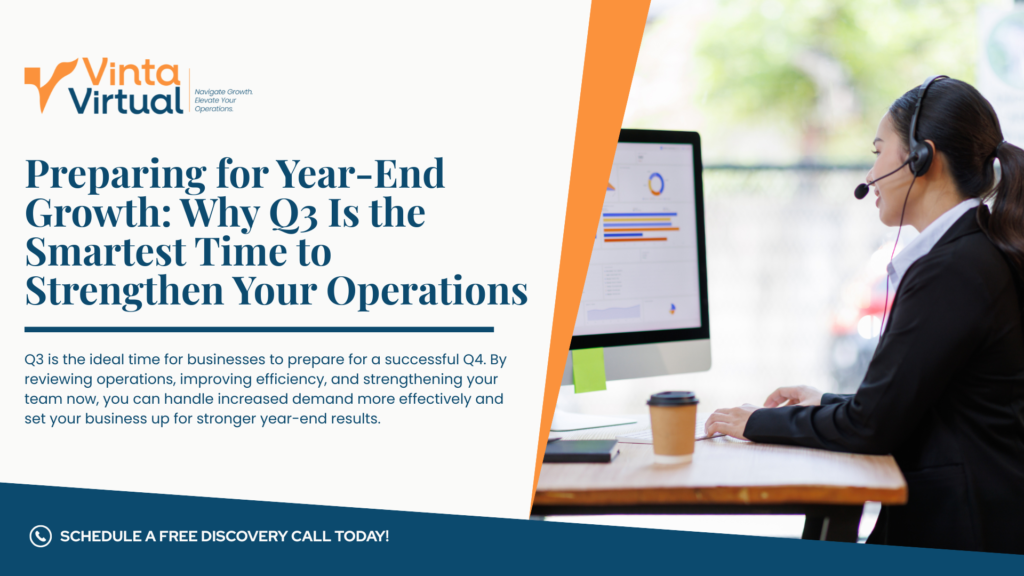
Why Q3 Is the Most Important Quarter for Operational Planning
Many organizations focus their planning efforts around Q4 because it is typically their busiest quarter.
Unfortunately, by the time Q4 arrives, it is often too late to improve operations.
Leadership is focused on serving customers.
Employees are managing increased workloads.
Managers are responding to daily challenges.
There is little capacity to redesign workflows, implement automation, improve reporting, or organize internal systems.
This is why Q3 presents a unique opportunity.
It gives organizations the time to evaluate their operational readiness before demand reaches its peak.
Rather than reacting to problems later, businesses can proactively strengthen the systems that support future growth.
Q3 is the ideal time to evaluate:
- Are our current processes scalable?
- Can our existing team support additional growth?
- Which repetitive tasks could be automated?
- Are managers spending enough time leading instead of coordinating?
- Does leadership have visibility into operational performance?
- Is our CRM supporting our business or creating additional work?
- Are workflows documented and consistently followed?
- Do employees know exactly what success looks like?
- Are we measuring the right KPIs?
- Can the business continue growing without creating additional operational bottlenecks?
These questions often reveal opportunities that can significantly improve performance before year-end.
Growth Should Never Depend on Working Harder
One of the biggest mistakes growing businesses make is believing that success requires everyone to simply work harder.
Working harder is not a long-term growth strategy.
Eventually, people become exhausted.
Managers become overwhelmed.
Leaders become bottlenecks.
Customers begin noticing inconsistent service.
Business growth should never rely solely on individual effort.
It should be supported by systems designed to make every employee more productive.
Organizations that scale successfully don’t simply add more people.
They create operational environments where people, processes, and technology work together.
That is the difference between growth and sustainable growth.
Building Operational Infrastructure with Vinta Virtual
At Vinta Virtual, we believe operational excellence begins long before businesses experience rapid growth.
Instead of simply providing administrative support, we help organizations build the operational infrastructure required to scale confidently.
Our approach combines the three essential components every growing business needs.
People
Experienced virtual professionals who integrate seamlessly into your organization and become an extension of your team.
Process
Documented workflows, standard operating procedures, operational accountability, quality assurance, and repeatable systems that create consistency across the business.
Platform
CRM optimization, workflow automation, operational reporting, dashboards, and integrated technology that provide leadership with greater visibility and control.
Together, these components create an operational infrastructure that allows organizations to:
- Improve operational efficiency.
- Reduce administrative overhead.
- Eliminate repetitive manual work.
- Increase team productivity.
- Standardize customer experiences.
- Improve accountability across departments.
- Strengthen communication.
- Gain greater visibility into operational performance.
- Support sustainable business growth.
- Scale confidently without unnecessary operational complexity.
Business growth should never feel overwhelming.
It should feel intentional.
It should feel organized.
Most importantly, it should be supported by an operational infrastructure designed to grow with your business.
At Vinta Virtual, that’s exactly what we help organizations build.